SEO Fundamentals: Why Google May Ignore Your Sitemap
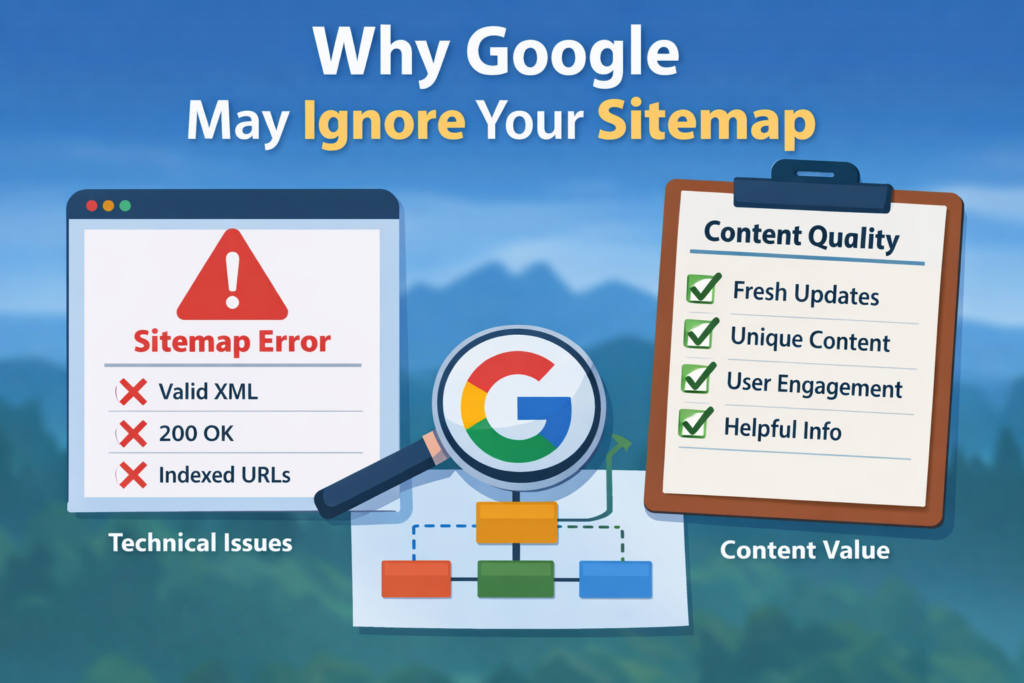
SEO Fundamentals Why Google May Ignore Your Sitemap
Submitting a sitemap in Google Search Console is one of the first technical steps in SEO. But what happens when your sitemap is technically correct — yet Google still shows a “Couldn’t fetch” or “Sitemap could not be read” error?
Recently, Google’s Search Advocate John Mueller addressed a similar concern where everything seemed technically perfect:
- Sitemap returned a 200 success response
- Valid XML format
- Proper
<loc>and<lastmod>tags - No indexing restrictions
- Server logs confirmed Googlebot successfully accessed the file
Yet, Google Search Console continued showing an error and most URLs listed in the sitemap were not being crawled.
So what’s happening?
Google Doesn’t Always Use a Sitemap
According to Google, simply submitting a sitemap does not guarantee indexing.
If Google is not convinced that your website has new, valuable, or important content, it may choose not to use the sitemap for crawling and indexing.
This means the issue may not be technical — it could be strategic.
What Does “Important Content” Mean?
When Google evaluates whether to crawl more pages from your site, it looks beyond technical setup. It considers:
- Content uniqueness
- Content depth and usefulness
- Overall site quality
- User engagement signals
- Authority and trust
- Content freshness
If your site does not frequently publish meaningful updates or if pages are thin, duplicated, or low-value, Google may ignore large parts of your sitemap.
Common Reasons Google May Ignore Sitemap URLs
- Thin or low-value content
- Duplicate or near-duplicate pages
- Poor internal linking structure
- Low domain authority
- Weak user engagement
- No clear search demand for the content
In such cases, Google may still crawl some manually submitted URLs but ignore the rest.
How to Fix the Problem
If your sitemap is technically valid but not being used effectively, focus on improving content quality and structure:
1. Improve Content Depth
Add detailed explanations, FAQs, visuals, examples, or step-by-step guides.
2. Strengthen Internal Linking
Make sure important pages are linked properly within your website.
3. Enhance User Experience
Clear navigation, mobile responsiveness, and fast loading speed matter.
4. Publish Valuable Content Regularly
Fresh, relevant updates increase Google’s interest in crawling your site.
5. Think Like a Visitor
Ask yourself:
- Does this page truly help the user?
- Is it better than competing pages?
- Would someone bookmark or share this content?
Key Takeaway
A sitemap is a helpful tool — but it does not force Google to index your pages.
Technical correctness is only the foundation.
Real SEO success comes from creating content that users find valuable, informative, and worth engaging with.
If Google is not using your sitemap, the solution may not be in your code — it may be in your content strategy.
If you’re experiencing issues with indexing, sitemap errors, or slow organic growth, it may be time to strengthen your overall SEO strategy. At DigitalFiverr Technologies, we provide complete SEO solutions including technical audits, content optimization, keyword research, on-page improvements, and authority-building strategies to help your website rank higher and get indexed faster. Instead of focusing only on technical fixes, we build a strong SEO foundation that improves visibility, traffic, and long-term search performance. Explore our SEO services to see how we can help your business grow online.
About The Author